Feeds:
Posts
Comments

 Our Afternoon of Music and Rugs was a great success last Saturday!  As well as the hypnotic sounds of Middle-Eastern Music, played by Maren Lueg and Chas Whittaker, we had Hamid Karimy valuing clients’ rugs and advising on their cleaning and repair and Wiktor Wyszynski of Tribal Rugs fascinating us with his talk about the rug-weaving nomads of Iran.  We plan to make this a regular event.

Maren Lueg & Chas Whittaker playing at Oriental Rugs of Bath November 2012

Hamid Karimy advising a customer about her rug as part of his Rug Clinic

Wiktor Wyszynski of Tribal Rugs talking about the rug-weaving nomads of Iran

It was rather popular, do come to the next one!

The mesmeric effect of Maren & Chas’s music!

Wiktor Wyszymski’s last diary entry for his rug buying trip to Iran: Day 5. Friday – Breakfast at 7.30. Interesting to watch the other guests in the hotel. There are no foreigners, but a lot of middle-class Iranian families with young children. Many people had taken an extra day off on Thursday, bridging the religious holiday and the weekly day of rest on Friday.

First port of call: seven brothers who produce gabbehs. The rugs re woven in the surrounding villages. Each brother has his own production, and when we select something they make a note of whose piece it was. We find some nice goods, though not as many as I’d hoped for; it seems that the brothers are responding to a demand, not from us, for totally plain goods, mostly in cream, devoid even of little animals in the corners.

Ornate tiles on a pillar in Shiraz

We then drive to my favourite Shiraz supplier: an elderly man who holds his stock in a Hosseiniyeh, a religious institution which, amongst other functions, distributes food to the poor. Enormous cauldrons are prominent in the courtyard. I love coming here because there are always some gems to be found amongst acres and acres of unsaleable goods. We find some remarkable old gabbehs, and some modern gabbehs with good designs. In fact we find so much that we stay too long and run into our next appointment – we’ll be back later.

Walk thorough the old quarters of the town, past the Armenian church, a huge Imamzadeh called, I think, Bibi Dokhtaran, and intriguing signs to a boutique hotel – probably a restored old house.

We get to our appointment – I’ve never been here before – and find some good gabbehs, and also some Qashqai, in various sizes. It’s now late afternoon, so we stop for lunch and go back to the Hosseiniyeh. More treasures: old gabbehs with trees, botehs, zigzags, stripes and leopards. I haven’t found any nice lions, which I was looking for specifically. The only ones I find have silly expressions, whereas I am looking for fierceness. But I do find some good representations of Darius and the Lion, which I hope to make the theme of a little exhibition in the autumn.

It’s now getting late; I was hoping to get a few hours’ rest before my 3 am. flight. But we have one more place to visit, in a suburban house, where we always find good pieces at fair prices. When we arrive, we’re offered some ‘Samanu’, a sticky dessert, not too sweet, based on malted wheat. We find gabbehs, bags, the two foot square mats I’ve been looking for, and finally I come upon a good stash of Jajims, with natural dyes and good clear designs. It’s pitch black when we finally finish measuring and ticketing them.

Back to the hotel for a quick dinner and a few hours in the room. I tot up my purchases, and realise I have hugely overspent, but in both Shiraz and Hamadan it seems I was the first buyer since the Persian New Year, and the stocks in both places were very good. Can’t sleep at all. I finish ‘Persia: An Archaeological Guide’ and at one o’clock join the two hour queue for the Istanbul flight.

an old Iranian doorway

Wiktor Wyszymski’s continued diary of his buying trip to Iran: Day 4. Thursday – Breakfast at 7 and out at 8 with our agent. Buying goods in Shiraz is a different experience from other cities. We hardly go to the bazaar, but to a succession of private houses, some of which are ancient and beautiful, in the old quarters of the town. Shiraz is famous for its gardens, and at this time of the year they are fragrant with jasmine and orange blossom.

In the first house we visit we find some good Qashqai, runners in 2 and 3 metre lengths, plus Abadeh and some old gabbehs. We also find some small Qashqai mats, about two feet square. We always sell these very well, but they are increasingly difficult to find.

This house has a beautiful painted wooden ceiling, in green and gilt, in one of the rooms. The medallion and corner design reflects the carpet which would have been placed on the floor.

The next house we visit is run by a father and son team. We’re rarely disappointed here, and find some good Qashqai in zaronim sizes, some Luri, some Abadeh, and some old Gabbeh. We also find some nice Afshar Sirjan.

The next house we visit is spectacular. The owner has roofed over the courtyard to serve as a warehouse. On the walls are some Qajar tile panels and, at dado level, some low relief carvings. We’ve come here to look for gabbehs, and find a good lot, in various sizes, colours and designs.

Lunch at the Arq Hotel: barley soup, and a kebab of ‘Shir-Mahi’ or lion fish, a firm-fleshed fish from the Gulf. Afterwards we buy some Faloudeh, the classic Shiraz dessert of frozen vermicelli with lemon juice.

More gabbehs in the afternoon, and then we visit an old acquaintance of ours with a clean modern warehouse and well selected clean goods, but at prices which would not disgrace a west-end dealer. I succumb, and take some old saddlebags and saltbags, and find some more accessibly priced Qashqai in zaronim sizes. It’s now 8.30 and night is falling, but we have a couple more people to visit, and find some very good old gabbehs, and coloured modern gabbehs in various sizes.

Back in the hotel after 10.30. The restaurant has closed, and we have to eat out. Amazing commercial activity at 1 am; whole families are out, and shops and street traders are doing a brisk trade.

Wiktor Wyszynski continues his buying trip in Iran

Day 2. Tuesday – Breakfast at 7 am. I’d slept, so decided on a big breakfast: fried eggs, sausage and a sort of bean stew, as well as bread, cheese, and slices of tomato and cucumber.

Wiktor Buying Rugs

Start in the bazaar at 8.30. our Hamadan agent has a new assistant who is a very good negotiator. We’re looking for decorative carpets in all sizes, runners and ‘kharaks’, and small mats. We go from one trader to another, and find some nice pieces: runners in all sizes, and some very good small rugs. We’re in a hurry for the next day, Wednesday, is a religious holiday, the anniversary of the death of Fatimah. The bazzar will be closed, and this could restrict our potential activity.

11 am. Feel unwell. Regret the big breakfast. We stop for lunch at 2pm and go to a restaurant overlooking the town, on the road to Ganj Nameh. But when lunch arrives, I can’t even look at it.

Feel terrible in the afternoon. But we continue to find nice goods. The biggest surprise is in a very unprepossessing basement. A wholesaler based in Germany has recently retired, leaving his agent with a quantity of Taleghan and Mazlaghan goods in all sizes, in a quality I haven’t seen for years. I buy up nearly the whole stock. We work until 10 pm in a thick fog of dust. When I get back to the hotel, wads of carpet dust fall out of my shirt like balls of grey cotton wool.  Dinner is a very retrained affair, and in bed by 1 am.

The Iranian Rug Mountain

Wiktor Wyszynski’s diary of a buying trip to Iran continues: Day 3. Wednesday – Breakfast too is restrained, though I feel a little better. The bazaar is closed today, but we can see the goods our Hamadan agent has put aside for us, and also some stocks which people have accumulated in their houses, and we have an appointment to see some Luri rugs in a washing factory in the early afternoon.

Little traffic about, though the car has to make detours to avoid the solemn processions which pass along the main roads. Every so often we pass a street preacher, surrounded by crowds whom he moves to tears. ‘Close your eyes and imagine, those of you who are mothers, the sufferings which Fatimah as a mother must have undergone’. The crowd wails.

A Florid Iranian Ceiling

We go to various private houses and look at stock in a succession of outhouses, warehouses and garden. Find some good pieces of various sizes, including Mahal. Lilihan and Kashan in large formats,  some Nahavands, some pretty Rudbar with birds, and even a Senneh kilim.

We stop for lunch at a new restaurant to eat ‘Ab-gusht’. I always thought this was simply the Persian word for a meat-based stock, but this is more sophisticated. A tall earthenware pot with a lid is brought to each diner. This contains a broth of meat and potatoes and vegetables. The liquid is poured into a ceramic bowl (difficult, because it’s very hot) and eaten as soup. The meat and vegetables are supposed to be mashed up with a pestle which is provided, and eaten with flatbread, though to my mind this was too much like homogenised baby-food and I preferred to eat mine unmashed.

More rugs in the afternoon.: some Bijar, some Nanaj, a nice pair of Faradombeh in the ‘gul-farang’ design, and some more runners. Then we drive out to see the Luri. Prices have crept up a little since last year, but the quality of the pieces is very high, and we even find a few pieces in carpet sizes.

It gets colder still as we go back to the hotel. During the drive back to Tehran it becomes very dark. The winds increase and we’re buffeted by driving rain, thunder, and hailstones the size of large eggs. Many drivers pull over.

Cleared up by the time we get to Tehran  airport. We arrive in Shiraz shortly after midnight, and are met bay our agent who drives us to the Park Hotel, one of the older hotels in the city and not one we normally use, but perfectly adequate, and with the advantage of being centrally situated. The temperature, even at night time, is very mild; we are several hundred miles further south.

Wiktor Wyszynski, who runs the London wholesaler Tribal Rugs, is a friend of and supplier to Oriental Rugs of Bath. He recently went on a buying trip to Iran and has kindly sent us excerpts from his diary of the trip

A Hamadan Street

Land at 01.15 (a civilised arrival time) and collected by Bahman our agent. The new airport is further away from town than the old, so we don’t get to the house till 3 am. Too excited to sleep and listen instead to the various birds in the garden.

“Woken” at 7. Delicious breakfast of eggs, bread, honey and cheese. By car to the bazaar, an hour away in the centre of town. Spend morning looking at various goods Bahman has collected for us: Meymey carpets, Turkmen, Heriz (more on these later), kharaks (small runners), kilims etc. Look in the bazaar for Veramin, but they’ve become very expensive. Apparently the production is much smaller than before.

Break for lunch: khoresht (stew) of aubergines and meat, with rice and yogurt, washed down with ayran, the refreshing yogurt based drink with salt and herbs.

Disappointment after lunch. Planned to select some Heriz carpets in various sizes, but the owner says the minimum quantity order is 60 pieces. We need only twenty. No amount of pleading will sway him.

3 pm. Leave by taxi for Hamadan. Choice of two routes: a quick one, partly motorway, via Saveh, and the more picturesque and archaeologically more interesting one through Qazvin. Taxi drivers always choose the former, so my hopes of seeing the very early mosque at Qurveh and the mausoleum at Takestan seem to be dashed. But at least we’ll get to Hamadan quickly. Scenery dramatic at only one point, with some ruins on a hilltop on the right: perhaps the remains of a fire temple.

There’s snow on the mountains around Hamadan. Weather cold and overcast. Wish I’d brought a jacket. Check in at the hotel at 7.30. It’s changed its name from ‘Revolution’ to ‘Freedom’ and become part of a chain, but the bathrooms are better and the restaurant etc unchanged. Unfortunately the expansion of the town has resulted in the beautiful view in front of the hotel, of farmland and poplars being replaced by an amusement park, with a concrete Apatosaurus on top of the helter-skelter.

rug haggling in Hamadan bazaar

Dinner at 9: barley soup, kebabs, and jelly for pudding (Northern Iran isn’t big on puddings). Lights off at 1 am, which is 9.30 bst.

Afghan Action’s trainees in Kabul make amazing rugs to order as several of our customers have discovered. On the 23rd of May, 2012 a beautiful 12 square metre carpet custom made by Afghan Action for St Michael’s College, Llandaff, Cardiff was unveiled. Designed by Marianne Osbourne, a former St Michael’s student, the carpet hangs on a wall in the College dining room  with a small plaque explaining how it came to be made. The College has been immensely supportive of Afghan Action since 2005.

The Archbishop of Wales, Barry Morgan, said a special prayer of blessing, praying for all those involved in Kabul in weaving this carpet and for the nation of Afghanistan. Carol Cobert, Chair of The Friends of St Michael’s, spoke about the College’s relationship with Afghan Action and Chris Beales, Afghan Action’s Chief Executive, described the work going on in Kabul. Present at the ceremony was Afghan Action advocate Shahnaz Hakim with her husband Shapor and son Zahir Radim, and

Katya Maiseyeva from Oriental Rugs of Bath with Chris Beales of Afghan Action

Katya Maiseyeva of Oriental Rugs of Bath, who stock Afghan Action’s carpets.

Picture of Naomi Gregory, interior designer South West UK

Naomi Gregory - Interior Designer

Naomi Gregory, one of the South West’s best Interior Designers, gives a professionals take on how to style the interior of your home including some great tips on the use of rugs in your home:

“Consider purchases for your home in the same way you would those for your wardrobe.”

Following fashion fads is all well and good if you have the resources to be able to discard your clothes and buy a new wardrobe again each season.  But for those who wish to spend their money wisely, classically tailored pieces in good fabrics are a far better investment.

So too with your home.

When I plan a scheme, I start by thinking about layout.  I like to create social spaces, by grouping furniture in a way that encourages conversation and interaction, preferably around a focal point.  (A piece of art, a stunning chandelier or an open fire all maker good focal points – open fires also add a great atmosphere).  Symmetry is also important as it creates a sense of balance and calm in the space.

I then consider the key items that are the building blocks of the scheme; in a living room for example these would likely be sofas and armchairs.

For these key items I choose classic styles that will stand the test of time – nothing too flamboyant.  The Snowdrop sofa from Sofa.Com is a timeless design and offers outstanding value for money.  I recommend upholstering in neutral colours for longevity and to match the neutrally painted walls.  And to anchor the furniture arrangement I use a large rug, setting the sofas and armchairs entirely on top of the rug.

Oriental Rug in a classicly decorated house with fireplace and mirror

How might an Oriental Rug look in your home?

The rug is a great starting point for your colour scheme.  I recommend choosing a multi-colour rug.  This means that there is more than one colour which can be picked out in cushions, curtains and accessories and allows you to easily update your design scheme in the future.

Oriental rugs are perfect for this providing a classic and timeless centre piece that wears well, tolerates family life and injects some warmth and personality in to your scheme.  I believe that we should be surrounded by the things that we love and that make us smile so choose a rug that you fall in love with and will enjoy using for years to come.

Picking out colours from your rug, (and here you can afford to be ‘on trend’ and select the colours that are most fashionable at the moment), find cushions, throws, bowls, vases and accessories that match your scheme.

Sticking to these basic principals you can be sure to create a successful interior scheme.  However, if you’d like more in-depth guidance please enter the competition with Oriental Rugs of Bath to win a home design consultancy with me!

You can win a personal consultation with Naomi worth £400 plus £500 worth of Oriental Rugs of Bath vouchers just by sharing an interior design feature you love in your home:


Click here to Enter The Competition on Facebook

some antique rugs we've recently restored

Last year we were commissioned to restore a stunning collection of some 30 antique rugs – some more than 150 years old – that had been in the same aristocratic family since their purchase in the 19th Century. They had 150 years of dust and grime embedded deep in their fibres and all that trampling had done quite some damage to the selvedges and torn a few holes.

typical damage to one of the antique rugs - a Serap.

the guy at the back is reweaving with the wool hanging above his head

Where the damage is too great for any other kind of repair, sections of a rug are rewoven

It’s amazing what a thorough but gentle clean and then a reweave of the holes and worn-out sections can achieve! Our restorers have been doing this work for generations in the same families.

restored rugs laid out for inspection in our client's recently restored room

In our continuing series into the origins and history of Oriental Rugs this week we take a look at 3 more types of rug from the Encyclopaedia that William Pryor (the owner of Oriental Rugs of Bath) has been writing over the past few years.

an aqche rug from oriental rugs of bath

An aqche rug from Oriental Rugs of Bath

Aqche Rugs (also Aqcha) are handmade by Turkmen living in the central part of the Afghan Province of Jowzjan around the town of Aqcha. Deep reds are their usual primary colour with octagonal rose, elephant foot and stylised flower motifs in

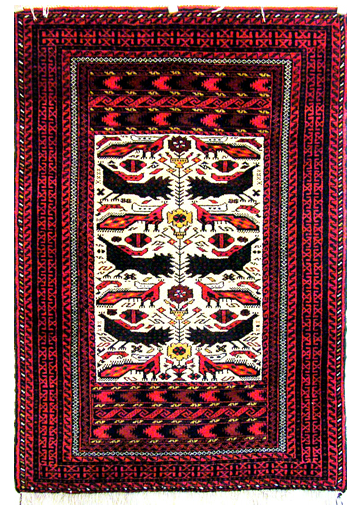
Belouch Rugs (also Beluch, Belutch, Belutsch, Balouch, Baloutche, Balúchi) are hand-knotted by different nomadic tribes that wander between Persia and western Afghanistan. (Belouch is a generic term for nomads in that area.) Belouch carpets are closely related to carpets from Afghanistan and Turkmenistan. Their colours tend to be dark red, dark blue, black and brown; their patterns geometrical with curvilinear life-trees. They are often designed as prayer carpets with a prayer niche. The workmanship is of high quality; these carpets are tight woven, thin and are fine examples of genuine nomadic handicraft. Mashad or Meshed Belouch car-pets are sold in the city of Mashad in Iran, while Herat Belouch carpets are sold in the city of Herat in Afghanistan. dark blue.

Bibikabad Rugs (also Bibik Abad) are woven in the Hamadan region of Iran and are related to Malayers in technique. They tend to come in all-over designs, usually the Herati pattern or Boteh (Paisley), which may at times have a medallion

A Belouch Rug from Oriental Rugs of Bath

A Belouch Rug from Oriental Rugs of Bath

Design a site like this with WordPress.com
Get started